|
 |


dog's age. A comparatively long time, Dogs who live into their teens are considered old dogs; almost none make it to 20 years. So perhaps a “dog's age” is a length of time of less than 20 years. Or it may simply be an interval of time between events that is longer than the expected interval. A quick search of the New York Times comes up with only two metaphorical uses in the last 15 years. In both cases, the general time range referred to was a matter of years rather than decades or centuries. In the first, a discussion of crime novels in the Book Review, Marilyn Stasio complained that “Peter Lovesey hasn't written a Sergeant Cribb mystery in a dog's age;” actually it had been about fifteen years.  I doubt that the Penguins' winning streak was more than a year or two old. In contrast, a year or two is not especially old for a dog, it is however, a relatively long time for a team to go undefeated on someone else's playing field. I doubt that the Penguins' winning streak was more than a year or two old. In contrast, a year or two is not especially old for a dog, it is however, a relatively long time for a team to go undefeated on someone else's playing field. |
1. Whitney, William Dwight and Benjamin E. Smith. 1914. The Century Dictionary and Cyclopedia; with a New Atlas of the World. New York: Century Co. Accessed from http:// www.global-language.com/century/.
2. Stasio, Marilyn. “Crime.” New York Times Book Review, Oct. 24 1993, 34.
3. Stasio, Marilyn. 1993. Crime. New York Times Book Review, Oct. 24, 34. Accessed May 23 2008 from http:// query.nytimes.com/ gst/fullpage.html? res= 9F0CE7DE1039 F937A15753C1 A965958260. |
||||||
 |
|||||||
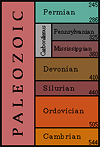
| About the illustration: Figure 1 is a diagram of the Paleozoic Era, which lasted a pretty long time—some 295 million years; that's probably much longer than a dog’s age. By the author. | |||||||
| cf: dog years; bird dog minute | Last updated: July 5, 2008 | ||||||



 though long compared to what is less clear.
 Given that Lovesey had been cranking out Peter Diamond novels in that period of time, it surely was not a matter of his productivity or established expectation. This case might argue for the age of a dog as the frame of reference.
 |

|